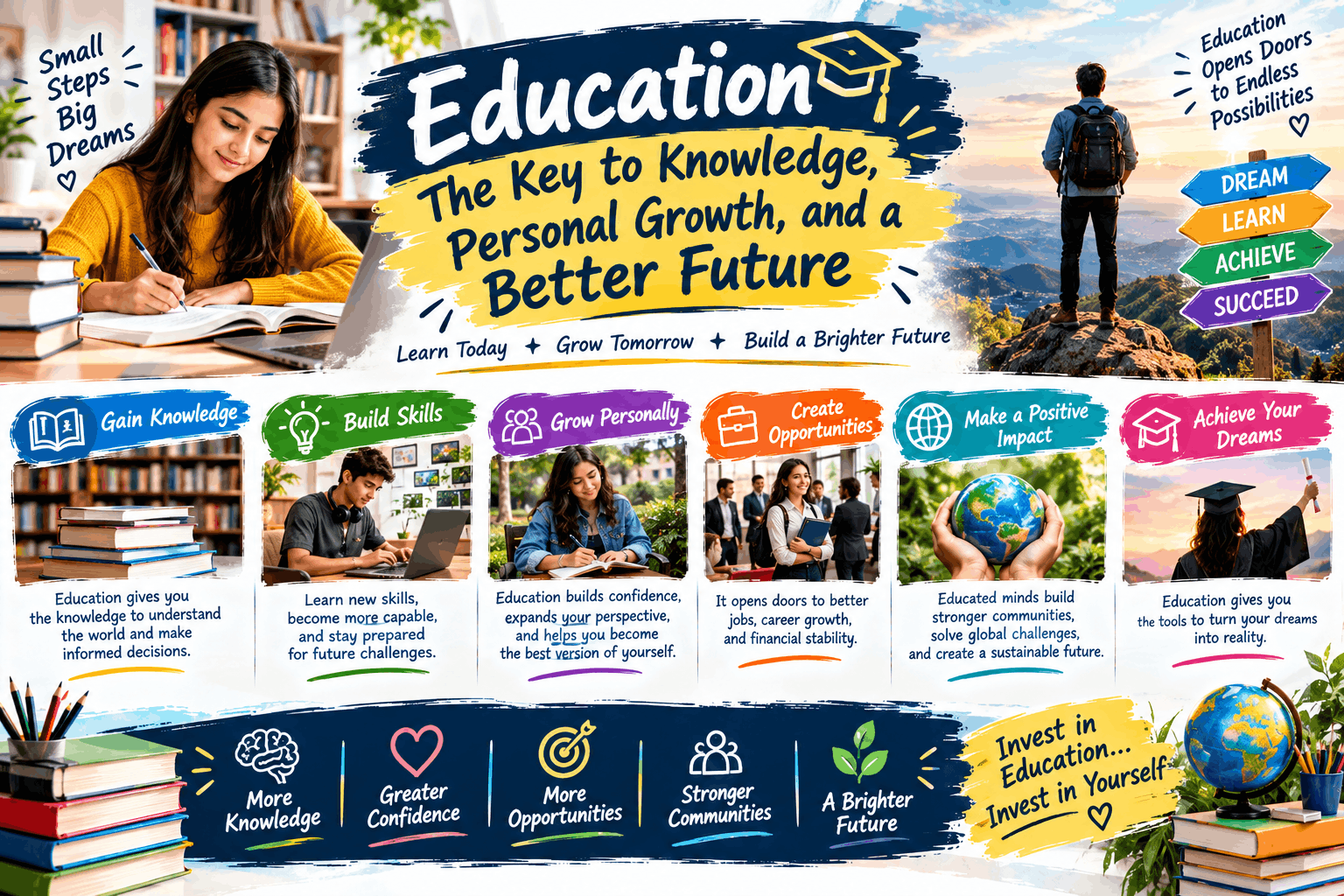
Education is one of the most important foundations of personal and social development. It gives people knowledge, develops skills, encourages critical thinking, and helps individuals understand the world around them. From early childhood learning to higher education and professional training, education continues throughout different stages of life.
In today’s rapidly changing world, education is more important than ever. Technology, artificial intelligence, global communication, and changing workplaces are creating new opportunities while also introducing new challenges. People need the ability to learn, adapt, solve problems, and develop new skills throughout their lives.
Education is not limited to classrooms or textbooks. It can happen at home, in schools and universities, through online courses, at workplaces, in libraries, and through everyday experiences. Learning can be formal or informal, individual or collaborative, theoretical or practical.
This article explores the importance of education, different forms of learning, the role of technology, challenges facing modern education, and the ways education can prepare people for a changing future.
What Is Education?
Education is the process of acquiring knowledge, skills, values, understanding, and abilities. It can occur through formal institutions such as schools and universities or through informal experiences and self-directed learning.
Traditional education often involves teachers, classrooms, textbooks, assignments, examinations, and structured curricula. Modern education has expanded to include digital learning platforms, virtual classrooms, educational applications, video lessons, online libraries, and interactive resources.
The purpose of education is broader than memorizing information. Effective education can teach people how to think, ask questions, evaluate information, communicate ideas, and solve problems.
Education also helps individuals discover interests and develop abilities that can contribute to personal and professional goals.
Why Education Is Important
Education can influence many areas of life.
For individuals, education can provide knowledge and skills needed for employment, communication, decision-making, and personal development.
For communities, education can support social participation, economic activity, innovation, and cultural development.
Education can also help people understand different perspectives. Learning history, science, literature, mathematics, languages, and social sciences can broaden understanding of the world.
A strong educational foundation can help individuals become more confident learners who are capable of adapting when circumstances change.
Early Childhood Education
Early childhood is an important period for learning and development.
Young children begin developing language, social, emotional, cognitive, and physical skills through interaction with parents, caregivers, teachers, and their environment.
Early education can introduce children to basic concepts such as numbers, letters, shapes, communication, cooperation, and problem-solving.
Play is also an important part of early learning. Games, stories, creative activities, music, and exploration can encourage curiosity and help children develop new skills.
A supportive learning environment can help children develop positive attitudes toward education from an early age.
Primary and Secondary Education
Primary education provides the foundation for many essential academic skills.
Students learn subjects such as mathematics, science, language, social studies, arts, and physical education. They also develop skills such as reading, writing, communication, teamwork, and organization.
Secondary education builds upon this foundation. Students may study more specialized subjects and begin thinking about future academic and career options.
Schools also provide opportunities for students to participate in sports, clubs, creative activities, community projects, and other experiences.
Education during these years is not only about academic performance. Developing confidence, responsibility, communication skills, and the ability to work with others can also be valuable.
Higher Education
Universities and colleges provide opportunities for advanced study and specialization.
Students can pursue fields such as medicine, engineering, business, computer science, education, law, arts, social sciences, and many others.
Higher education can provide deeper knowledge within a chosen discipline while also developing research, analytical, communication, and problem-solving skills.
University education can also expose students to new ideas, cultures, research, and professional networks.
However, higher education is not the only path to a successful career. Vocational education, professional certifications, apprenticeships, entrepreneurship, and practical training can also provide valuable career opportunities.
Vocational and Technical Education
Vocational education focuses on practical skills and specific occupations.
Programs may cover areas such as electrical work, construction, automotive technology, healthcare support, hospitality, information technology, design, manufacturing, and other technical fields.
Vocational training can help learners develop skills that are directly applicable to particular jobs.
Technical education is especially valuable in industries where practical knowledge and specialized abilities are important.
A strong education system can provide multiple pathways so that students can choose options that match their interests, abilities, and career goals.
Online Education
The internet has transformed education.
Online learning platforms allow students to access courses, lectures, tutorials, digital books, practice exercises, and educational communities from many locations.
Students can study subjects ranging from mathematics and programming to languages, business, design, and personal development.
Online education can provide flexibility for people who have jobs, family responsibilities, or limited access to traditional educational institutions.
However, online learning also requires self-discipline. Students may need to manage their schedules, avoid distractions, complete assignments independently, and communicate digitally.
A combination of online resources and traditional instruction can provide valuable learning opportunities.
The Role of Teachers
Teachers play an important role in education.
A teacher does more than deliver information. Teachers can explain difficult concepts, provide feedback, encourage curiosity, identify learning challenges, and help students develop confidence.
Good teaching often involves adapting explanations to different learning needs.
Teachers can also help students understand how knowledge connects to real-world situations.
Technology may provide access to enormous amounts of information, but teachers remain important in helping learners understand, evaluate, and apply that information.
Technology in Education
Technology has changed how students and teachers access information.
Interactive whiteboards, educational applications, video conferencing, digital textbooks, online libraries, learning management systems, and virtual laboratories can expand learning opportunities.
Students can watch educational videos, complete interactive exercises, collaborate on digital projects, and access resources beyond their local classrooms.
Technology can also help teachers organize assignments and monitor student progress.
However, technology should be used thoughtfully. Digital tools should support learning rather than become distractions.
Access is another important issue. Not every student has the same access to reliable internet, computers, or other devices. Educational systems need to consider these differences when adopting technology.
Artificial Intelligence and Education
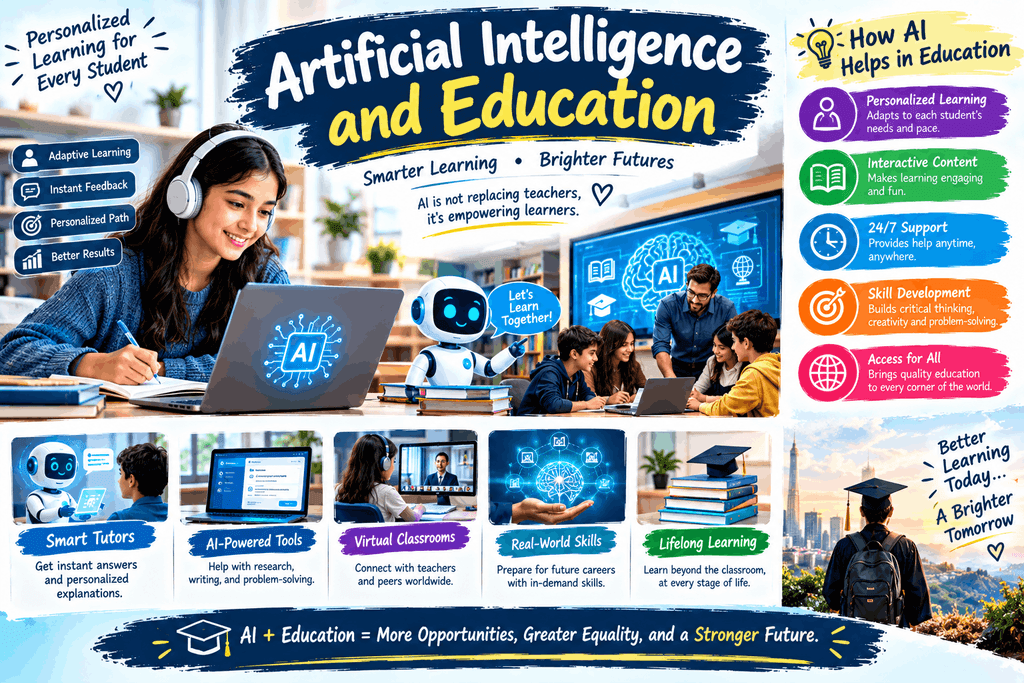
Artificial intelligence is becoming increasingly relevant to education.
AI-powered tools can help learners practice concepts, generate explanations, organize information, translate text, and receive personalized assistance.
Teachers may also use AI-supported tools for administrative tasks, lesson preparation, and educational analysis.
However, AI should be treated as a learning support rather than a replacement for independent thinking.
Students need to understand information, evaluate sources, solve problems, and develop their own ideas.
Schools and educational institutions are also considering questions about academic integrity, privacy, accuracy, and appropriate AI use.
The ability to use AI responsibly may become an important digital skill in modern education.
Critical Thinking and Problem-Solving
One of the most valuable purposes of education is developing the ability to think critically.
Critical thinking involves examining information, asking questions, identifying assumptions, comparing evidence, and reaching reasoned conclusions.
In the digital age, people encounter enormous amounts of information every day. Not all information is accurate or reliable.
Education can help students learn how to evaluate sources and distinguish evidence-based information from unsupported claims.
Problem-solving is another important skill. Students who learn how to approach unfamiliar problems can apply their knowledge in new situations.
These skills can be useful in education, employment, personal decisions, and everyday life.
Education and Career Development
Education can help people prepare for employment and professional development.
Academic qualifications may be required for certain careers, while practical skills and experience may be more important in others.
Modern workplaces increasingly value skills such as communication, teamwork, adaptability, digital literacy, problem-solving, and creativity.
Career preparation should therefore extend beyond examination results.
Students can benefit from internships, projects, volunteering, practical training, career counseling, networking, and other experiences that connect education with real-world applications.
Lifelong Learning
Education does not end when someone graduates.
Industries change, technology develops, and new knowledge emerges. Professionals may need to learn new software, update technical skills, or understand new practices.
Lifelong learning involves continuing to acquire knowledge and skills throughout life.
People can learn through professional courses, books, online programs, workshops, conferences, hobbies, and personal experiences.
A willingness to keep learning can help individuals adapt to changing circumstances.
The Importance of Reading
Reading is one of the most accessible forms of learning.
Books, newspapers, academic publications, websites, and digital resources can introduce readers to new ideas and perspectives.
Regular reading can support vocabulary, comprehension, knowledge, and critical thinking.
Reading does not have to focus exclusively on academic subjects. Fiction, history, biographies, science, technology, travel, and other topics can all provide valuable knowledge.
Developing a regular reading habit can make learning a natural part of everyday life.
Education and Creativity
Education should create opportunities for creativity.
Creative activities such as writing, painting, music, design, theater, photography, and experimentation can help learners express ideas and explore new possibilities.
Creativity is not limited to the arts. Scientists, engineers, entrepreneurs, programmers, and business professionals also use creativity to develop solutions.
Educational environments that encourage questions and experimentation can help students become more comfortable with exploring ideas.
The Role of Parents and Families
Education is influenced by more than schools.
Parents and family members can support learning by encouraging curiosity, reading, discussion, organization, and healthy study habits.
A supportive home environment can help students feel comfortable asking questions and discussing challenges.
Parents can also help children understand that learning is a process. Mistakes can provide opportunities to identify areas for improvement.
The goal should not simply be to achieve high grades but to develop confidence, curiosity, responsibility, and a lasting interest in learning.
Challenges in Modern Education
Education systems face many challenges.
One major challenge is unequal access. Students may have different levels of access to qualified teachers, technology, educational materials, transportation, and safe learning environments.
Another challenge is ensuring that curricula remain relevant. Students need foundational knowledge as well as skills that prepare them for changing workplaces and societies.
Student stress is another important concern. Excessive academic pressure can affect motivation and well-being.
Educational institutions need to consider both academic achievement and students’ broader development.
Improving Study Habits
Students can improve learning by developing effective study habits.
Instead of waiting until the last moment, students can divide large assignments into smaller tasks.
Active learning methods can also be useful. These include practicing questions, explaining concepts in your own words, creating summaries, using flashcards, and testing yourself.
Taking breaks can help maintain concentration during longer study sessions.
A suitable study environment can also make a difference. Reducing unnecessary distractions and keeping materials organized can help students focus.
Different students learn in different ways, so it is useful to experiment with study methods and identify what works best.
Education and Social Development
Education can influence how people interact with their communities.
Schools and universities bring together people with different backgrounds and experiences. Students can learn cooperation, communication, responsibility, and respect through group activities and shared experiences.
Education can also introduce learners to history, culture, civic institutions, science, and social issues.
Understanding different perspectives can help individuals communicate more effectively and participate constructively in their communities.
The Future of Education
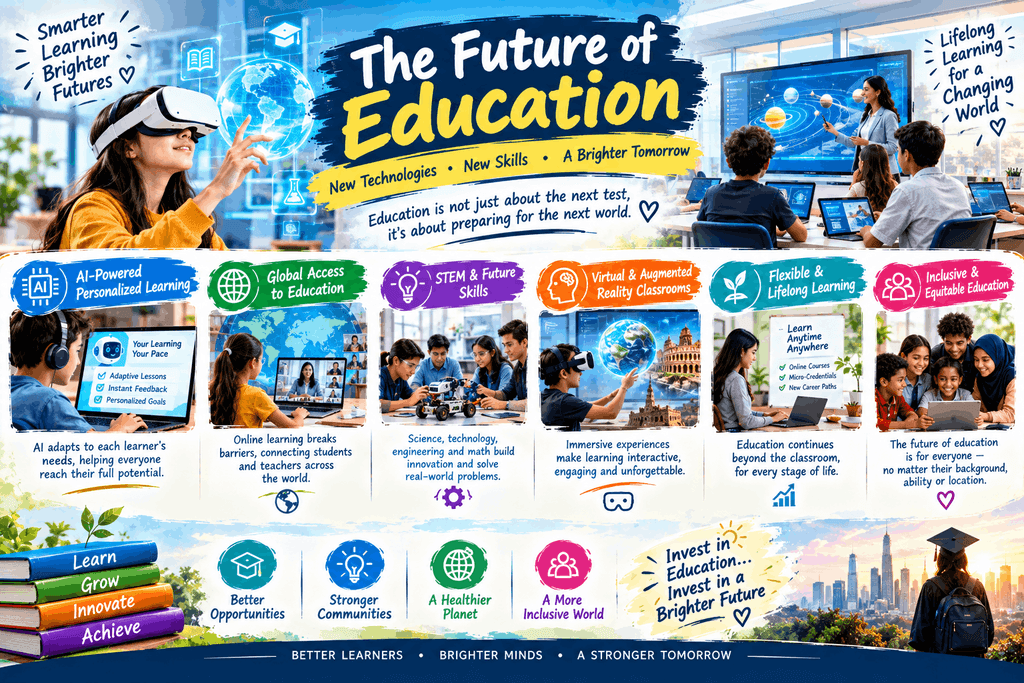
The future of education is likely to become increasingly flexible and technology-driven.
Artificial intelligence, virtual learning environments, digital resources, interactive simulations, and personalized learning tools may change how students study.
However, technology will not eliminate the need for fundamental educational skills.
Reading, writing, mathematics, communication, critical thinking, creativity, collaboration, and problem-solving will remain important.
Future education may place greater emphasis on learning how to learn rather than memorizing large amounts of information.
Students may increasingly move between traditional classrooms, online courses, practical experiences, and independent learning.
Conclusion
Education is one of the most powerful tools for personal development and social progress. It provides knowledge, develops skills, encourages curiosity, and helps people understand the world around them.
A strong education system should provide opportunities for academic learning, practical training, creativity, critical thinking, technology use, and personal development.
Education also extends beyond schools and universities. Learning can happen through books, conversations, work experiences, online resources, hobbies, travel, and everyday life.
As technology continues to transform society, the ability to learn and adapt will become increasingly valuable. Students and professionals will need to develop not only knowledge but also the ability to evaluate information, solve unfamiliar problems, communicate effectively, and continue learning throughout their lives.
Ultimately, education is not simply about earning qualifications. It is about developing the knowledge, skills, curiosity, and confidence needed to navigate life and contribute meaningfully to the world.
By investing in education, individuals can expand their opportunities, families can support future generations, communities can strengthen their capabilities, and societies can prepare for the challenges and opportunities of the future.