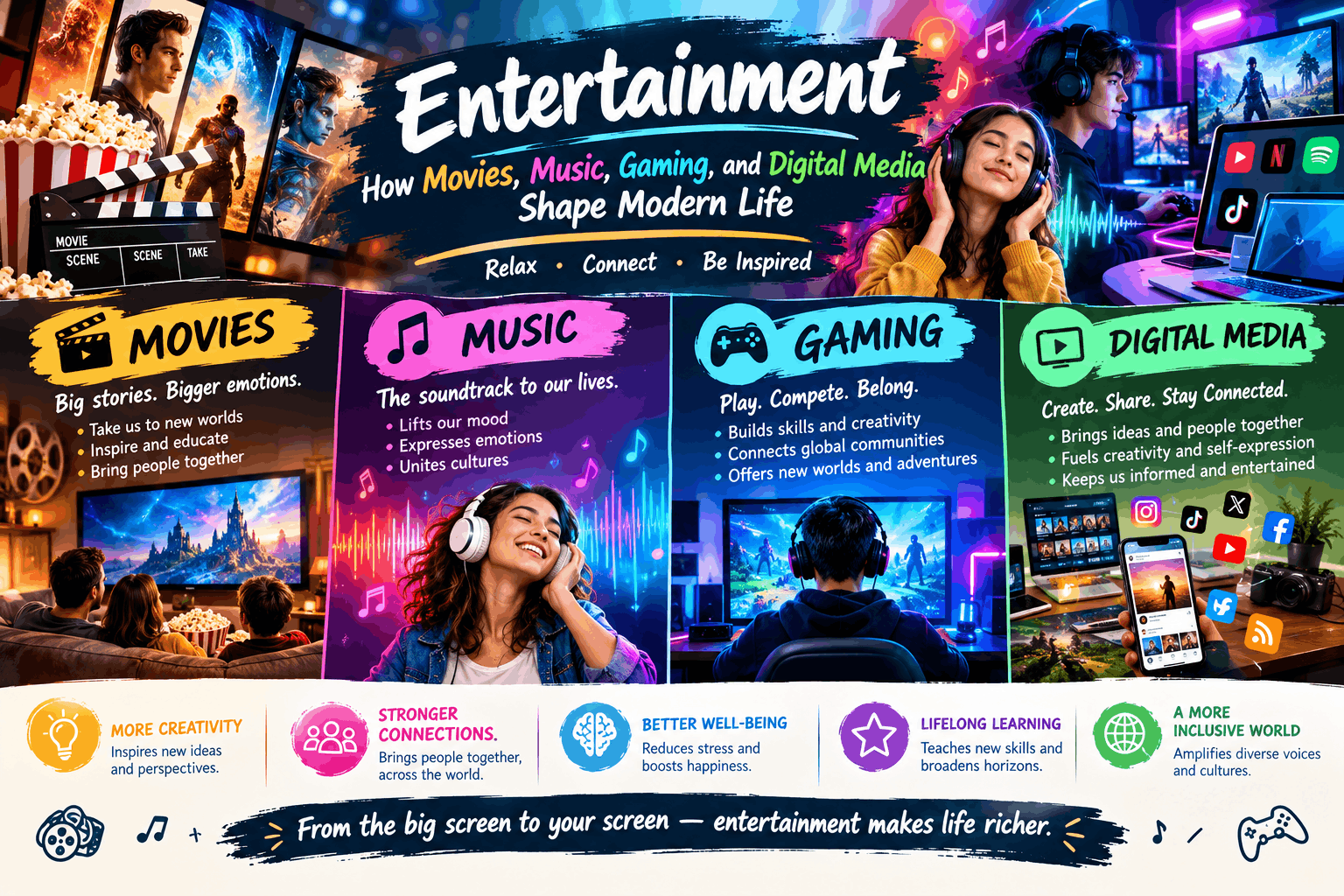
Entertainment has always been an important part of human life. From traditional storytelling and live performances to movies, music, television, video games, streaming platforms, and social media, entertainment continues to evolve alongside society and technology.
People seek entertainment for many different reasons. It can provide relaxation after a busy day, create opportunities to spend time with friends and family, introduce audiences to new ideas, and offer an escape from everyday routines. Entertainment can also bring people together through shared experiences, popular culture, sports, concerts, festivals, and online communities.
The modern entertainment industry is more diverse and accessible than ever. A person with a smartphone and an internet connection can watch films, listen to music, play games, follow creators, read stories, or discover new forms of content from around the world.
At the same time, the rapid growth of digital entertainment has changed how content is created, distributed, and consumed. Traditional television and cinema now exist alongside streaming services, social media platforms, podcasts, livestreams, and interactive digital experiences.
This article explores the world of modern entertainment, its major forms, technological developments, benefits, challenges, and possible future trends.
What Is Entertainment?
Entertainment refers to activities, content, or experiences designed to provide enjoyment, interest, relaxation, excitement, or emotional engagement.
Entertainment can include:
- Movies and cinema
- Television programs
- Music
- Video games
- Theater
- Comedy
- Books and storytelling
- Podcasts
- Social media content
- Live events
- Festivals
- Sports entertainment
- Streaming content
- Digital creators
- Virtual and interactive experiences
Different people enjoy different types of entertainment. Some prefer quiet activities such as reading, while others enjoy concerts, gaming, sports, or large social events.
The variety of entertainment available today means that audiences can choose experiences based on their interests, schedules, and budgets.
Movies and Cinema
Movies remain one of the most influential forms of entertainment.
Cinema can transport audiences into fictional worlds, historical periods, imaginary futures, or realistic stories about everyday life. Films can make people laugh, cry, think, or experience suspense and excitement.
Modern filmmaking combines storytelling with advanced visual effects, sound design, cinematography, animation, and computer-generated imagery.
Movie genres include:
- Action
- Comedy
- Drama
- Romance
- Horror
- Science fiction
- Fantasy
- Documentary
- Animation
- Thriller
- Mystery
- Adventure
Cinema also provides opportunities for cultural exchange. Films produced in different countries can introduce audiences to unfamiliar languages, traditions, landscapes, and social experiences.
Although streaming has changed the way people watch movies, cinemas continue to offer a unique shared experience through large screens, powerful sound systems, and communal viewing.
Television and Streaming
Television has evolved significantly over the years.
Traditional television schedules once determined when audiences could watch programs. Streaming services introduced a more flexible model in which viewers can often choose what they want to watch and when they want to watch it.
Streaming has expanded the variety of available content. Audiences can access movies, series, documentaries, reality programs, children’s content, live events, and international productions.
One major advantage of streaming is convenience. Viewers can watch content on televisions, computers, tablets, and smartphones.
However, the large number of available services can also make choosing something to watch more difficult. Subscription costs can accumulate when households use several platforms.
Music and the Digital Revolution
Music is one of the oldest and most universal forms of entertainment.
People listen to music for relaxation, celebration, exercise, concentration, emotional expression, and social connection.
The music industry has undergone major changes as technology has developed.
Physical formats such as vinyl records, cassettes, and CDs were followed by digital downloads and then streaming services.
Today, listeners can discover songs from artists around the world almost instantly.
Digital platforms have also created new opportunities for independent musicians. Artists can use social media and online distribution tools to reach audiences without relying entirely on traditional record companies.
Live concerts remain an important part of the music industry. They provide an experience that recorded music cannot fully reproduce.
Video Games
Video games have developed from simple electronic entertainment into a major global cultural industry.
Modern games can combine storytelling, music, art, strategy, competition, exploration, and social interaction.
Players can enjoy many different genres, including:
- Action games
- Adventure games
- Role-playing games
- Strategy games
- Sports games
- Racing games
- Puzzle games
- Simulation games
- Multiplayer games
Online gaming has also created communities where players can communicate and compete with people from different locations.
Gaming technology continues to develop through more powerful hardware, realistic graphics, virtual reality, cloud gaming, and interactive storytelling.
Video games can provide entertainment and opportunities for problem-solving and collaboration, although maintaining a healthy balance with other activities is important.
Social Media Entertainment
Social media has become a major source of entertainment.
Platforms allow users to watch short videos, follow creators, share photographs, listen to music, participate in discussions, and discover trends.
Unlike traditional media, social media allows audiences to become content creators themselves.
A person can record a video, edit it on a smartphone, and publish it to a global audience.
This has created opportunities for influencers, comedians, educators, musicians, artists, reviewers, and other independent creators.
However, social media entertainment can also encourage continuous scrolling. Users may benefit from setting reasonable boundaries around screen time and taking regular breaks.
Podcasts and Audio Entertainment
Podcasts have become an increasingly popular form of entertainment and information.
Podcasts cover almost every subject, including comedy, storytelling, technology, business, history, science, culture, sports, and personal experiences.
One advantage of podcasts is that they can be consumed while performing other activities such as walking, commuting, or exercising.
Audio storytelling can create a strong sense of connection between hosts and audiences.
Podcasting has also lowered barriers for independent creators. Individuals with suitable recording equipment and a clear idea can produce their own programs and develop an audience.
Theater and Live Performances
Live theater remains an important part of entertainment despite the growth of digital media.
Theater provides a unique experience because performers and audiences share the same physical space.
Plays, musicals, stand-up comedy, dance performances, and other live shows can create a sense of community and immediacy.
Unlike recorded content, live performances can change from one show to another. Audience reactions, performer interactions, and unexpected moments can become part of the experience.
Local theater can also provide opportunities for emerging performers and support cultural communities.
Books and Storytelling
Reading is another form of entertainment that remains relevant in the digital age.
Novels, short stories, biographies, comics, and other forms of written storytelling allow readers to imagine characters, worlds, and experiences.
Books can provide entertainment while also encouraging imagination and reflection.
Digital books and audiobooks have made literature more accessible to people who prefer electronic formats.
Stories can also connect people across cultures and generations.
Comedy and Stand-Up Entertainment

Comedy provides a way for people to relax and enjoy humor.
Stand-up performances, comedy shows, online sketches, films, television programs, and social media videos all provide different forms of comedic entertainment.
Comedy often reflects everyday experiences, cultural observations, and social situations.
Because humor can vary significantly between cultures and individuals, successful comedy often depends on understanding the audience.
Live Events and Festivals
Festivals, concerts, cultural events, exhibitions, and public celebrations can create memorable entertainment experiences.
Live events allow people to participate rather than simply watch.
Music festivals may combine performances with food, art, social activities, and cultural experiences.
Local festivals can also highlight traditions and provide economic opportunities for communities.
Events bring people together and create shared experiences that can be difficult to reproduce through digital platforms.
Celebrity and Popular Culture
Celebrities and public figures play a significant role in modern entertainment culture.
Actors, musicians, athletes, creators, and other public figures can influence fashion, music, film, social media trends, and consumer interests.
Social media has changed the relationship between celebrities and audiences. Fans can often see behind-the-scenes content, interviews, livestreams, and personal updates directly from public figures.
At the same time, audiences should remember that social media content often represents a carefully selected portion of a person’s life.
Entertainment and Technology
Technology has transformed almost every part of entertainment.
High-speed internet allows large amounts of video and audio content to be delivered quickly.
Smartphones have turned entertainment into a portable experience. People can watch videos, listen to music, play games, and read books almost anywhere.
Artificial intelligence is also being used in areas such as content recommendation, visual effects, music tools, game development, and editing.
Virtual reality and augmented reality could create even more immersive forms of entertainment in the future.
The Rise of Virtual Reality
Virtual reality allows users to interact with digital environments using specialized headsets and controllers.
VR can be used for gaming, interactive storytelling, virtual experiences, simulations, and entertainment.
Instead of watching a character explore a digital world from a traditional screen, users can become more directly immersed in the environment.
As hardware becomes more accessible and software develops, VR may become an increasingly important part of entertainment.
Artificial Intelligence and Entertainment
Artificial intelligence is influencing how entertainment content is created and distributed.
AI-powered tools can assist with tasks such as editing, visual effects, recommendation systems, translation, animation, and content organization.
AI can also help audiences discover content based on their interests.
However, the use of AI in creative industries raises important questions about originality, copyright, authorship, employment, and responsible technology use.
The relationship between human creativity and AI will likely continue to develop as the technology becomes more capable.
Entertainment and Social Connection
Entertainment can bring people together.
Friends may watch a movie together, families may play games, fans may attend concerts, or online communities may discuss their favorite shows.
Shared entertainment experiences can create conversations and strengthen relationships.
Online communities can also connect people who share interests but live in different parts of the world.
However, digital interaction works best when balanced with real-world relationships and activities.
The Importance of Healthy Entertainment Habits
Entertainment is valuable, but excessive consumption can interfere with other parts of life.
Spending too much time watching videos, gaming, scrolling social media, or using digital devices can reduce time available for sleep, exercise, work, study, and relationships.
A balanced approach involves choosing entertainment intentionally.
People can set limits, take regular breaks, and make time for offline activities.
Entertainment should ideally add enjoyment to life rather than replace essential responsibilities.
Choosing Quality Entertainment
With enormous amounts of content available, audiences have more choices than ever.
Quality is subjective, but viewers can consider factors such as storytelling, creativity, originality, production quality, educational value, and personal enjoyment.
Recommendations can help people discover new content, but algorithms may sometimes create narrow content feeds.
Exploring different genres, creators, countries, and formats can help audiences discover new interests.
The Business of Entertainment
Entertainment is also a major economic industry.
Film studios, music companies, streaming platforms, gaming companies, theaters, publishers, event organizers, advertising agencies, and independent creators all contribute to the entertainment economy.
Revenue can come from ticket sales, subscriptions, advertising, merchandise, licensing, sponsorships, digital purchases, and live events.
Digital platforms have created new business models for creators. Some individuals can build careers through online video, podcasts, streaming, music, or other forms of digital content.
The Future of Entertainment
The future of entertainment will likely become more interactive, personalized, and connected.
Streaming will continue to influence how people consume video and audio. Gaming may become increasingly social and immersive. Virtual and augmented reality could create new forms of storytelling.
Artificial intelligence may assist creators with production tasks while recommendation systems become more personalized.
At the same time, audiences may continue to value live experiences because concerts, theater, festivals, and other events provide social interaction that digital entertainment cannot completely replace.
The entertainment industry will likely continue combining traditional formats with emerging technologies.
Entertainment for Everyone
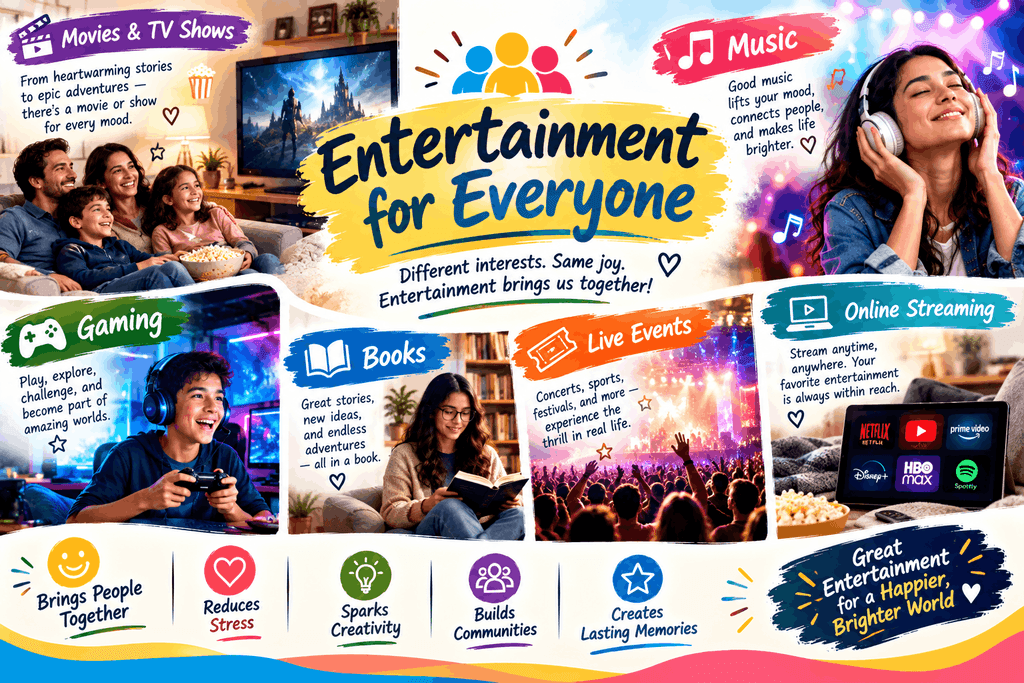
One of the most positive developments in modern entertainment is the diversity of content available.
Audiences can discover stories from different countries, cultures, languages, and communities.
International films, global music, independent games, translated books, and online creators have made entertainment more diverse.
Accessibility is also becoming increasingly important. Captions, audio descriptions, adaptable interfaces, and other features can help more people enjoy entertainment.
Conclusion
Entertainment is an important part of modern life. Movies, music, television, gaming, books, podcasts, theater, social media, live events, and digital experiences provide countless ways for people to relax, connect, explore ideas, and enjoy their free time.
Technology has dramatically changed the entertainment landscape. Smartphones, streaming platforms, high-speed internet, artificial intelligence, virtual reality, and digital creation tools have made content more accessible and interactive.
At the same time, traditional forms of entertainment remain valuable. Going to the cinema, attending a concert, reading a book, watching a live performance, or spending an evening playing a game with friends can create meaningful experiences.
The future of entertainment will likely combine technology with human creativity. New tools will create new possibilities, but storytelling, music, humor, imagination, and shared experiences will remain at the heart of entertainment.
Ultimately, entertainment is about more than simply passing time. It can help people relax after demanding days, connect with others, discover new perspectives, express creativity, and create memories. By choosing entertainment thoughtfully and maintaining a healthy balance with other areas of life, people can enjoy the many possibilities of the modern entertainment world while continuing to make time for the experiences that matter most.