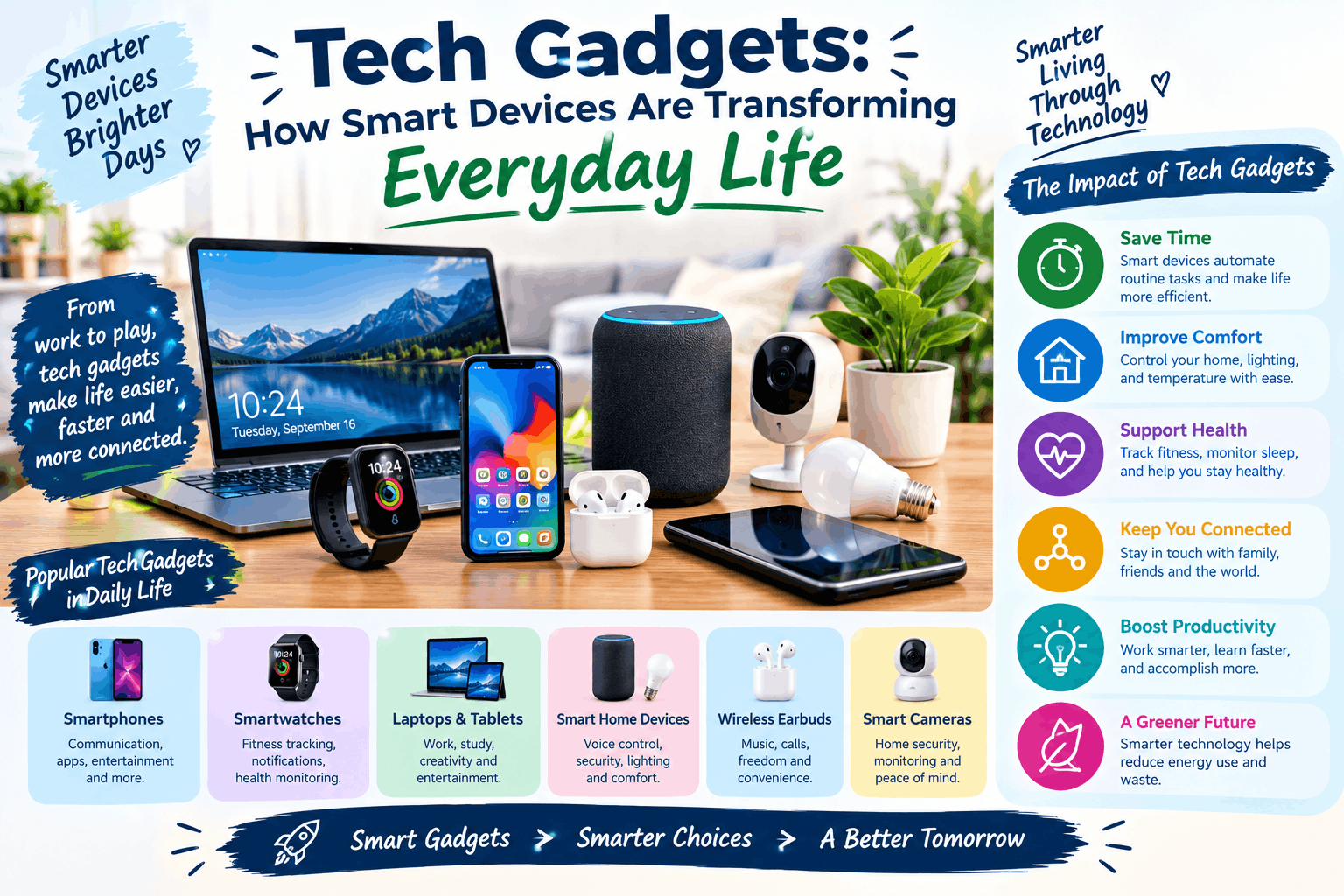
Technology has become an essential part of modern life. From the moment we wake up to the time we go to sleep, technology surrounds us in countless ways. Smartphones help us communicate, smartwatches monitor our activities, wireless earbuds provide entertainment, and laptops allow us to work from almost anywhere. As technology continues to advance, tech gadgets are becoming smarter, smaller, faster, and more useful.
Tech gadgets are no longer limited to expensive computers or complicated electronic equipment. Today, there is a gadget for almost every aspect of daily life, including communication, entertainment, education, fitness, travel, home management, and productivity. Many of these devices are designed to save time, improve convenience, and provide new ways to interact with the digital world.
In this article, we explore the world of modern tech gadgets, the most popular categories, their benefits, emerging trends, and what the future may hold for smart devices.
What Are Tech Gadgets?
Tech gadgets are electronic devices designed to perform specific functions or make everyday activities easier. They can range from simple accessories to advanced smart devices powered by artificial intelligence, wireless connectivity, sensors, and cloud technology.
A smartphone is one of the most familiar examples. It combines communication, photography, navigation, entertainment, banking, shopping, and many other functions in a single device. Other examples include smartwatches, tablets, wireless headphones, smart speakers, gaming consoles, portable chargers, smart home devices, and virtual reality headsets.
The popularity of gadgets has increased because consumers want technology that is convenient and easy to use. Manufacturers are responding by creating products that combine multiple features while becoming increasingly portable.
Smartphones: The Center of the Modern Digital World
Smartphones remain among the most important gadgets in everyday life. Modern smartphones are much more than devices for making calls and sending messages. They function as cameras, entertainment centers, navigation tools, payment devices, productivity assistants, and personal communication platforms.
Today’s smartphones typically feature powerful processors, high-resolution displays, multiple cameras, biometric security, fast charging, and wireless connectivity. Many models also include artificial intelligence features that can help with photography, writing, translation, voice recognition, and organization.
Photography has become a particularly important smartphone feature. Even relatively compact phones can capture detailed photographs and high-quality video. Advanced image processing can improve photos in challenging lighting conditions, stabilize video, and automatically adjust colors and exposure.
Smartphones have also changed the way people work. Mobile applications allow users to manage emails, participate in video meetings, edit documents, access financial services, and communicate with colleagues while away from a traditional office.
However, smartphones also create challenges. Excessive screen time, distractions, privacy concerns, and frequent upgrades are issues that consumers need to consider. Choosing a smartphone should therefore involve more than simply looking at its newest features.
Smartwatches and Wearable Technology
Wearable technology has become another major part of the gadget market. Smartwatches combine traditional watch functions with digital features such as notifications, fitness tracking, navigation, music control, and communication.
Many modern smartwatches contain sensors that can monitor activities such as steps, exercise sessions, heart rate, sleep patterns, and other measurements. These features can encourage people to become more aware of their daily habits.
Smartwatches can also be useful for productivity. Users can receive notifications, check calendars, control music, respond to messages, and perform other tasks without constantly taking out their phones.
Fitness trackers offer a simpler alternative for people who mainly want activity-monitoring features. They are often lightweight and designed specifically for exercise and wellness tracking.
As wearable technology develops, manufacturers are experimenting with new designs and capabilities. Smart rings, advanced fitness devices, and connected accessories are expanding the wearable technology category beyond traditional watches.
Wireless Earbuds and Headphones
Wireless audio gadgets have transformed the way people listen to music, podcasts, audiobooks, and online content. Traditional wired headphones remain useful, but wireless earbuds have become particularly popular because of their compact design and convenience.
Modern wireless earbuds can offer features such as active noise cancellation, transparency modes, touch controls, voice assistants, and automatic device switching. Some models are designed for exercise and include water or sweat resistance.
Noise cancellation is especially useful in busy environments. It can reduce background sounds while users listen to music, watch videos, or participate in calls.
Battery life is another important consideration. Small charging cases allow users to recharge earbuds while carrying them, making wireless audio devices convenient for travel and daily use.
Audio technology continues to improve, but consumers should consider comfort, sound quality, microphone performance, battery life, durability, and compatibility rather than focusing only on specifications.
Tablets: Portable Productivity and Entertainment
Tablets occupy a space between smartphones and laptops. Their larger screens make them useful for reading, watching videos, browsing the web, attending online classes, drawing, gaming, and completing productivity tasks.
For students, tablets can provide access to digital textbooks, educational applications, online courses, and note-taking tools. With a compatible keyboard and stylus, some tablets can also become practical productivity devices.
Creative professionals can benefit from tablets with high-quality displays and pressure-sensitive styluses. Digital artists can draw directly on the screen, while photographers and designers can use tablets for editing and reviewing creative projects.
Tablets are also popular entertainment devices. Their larger screens are more comfortable than smartphones for watching movies, reading, and playing games.
The choice between a tablet and laptop depends largely on the user’s needs. Tablets generally emphasize portability and touchscreen interaction, while laptops usually provide a more traditional computing environment.
Laptops and Portable Computers
Laptops remain essential gadgets for work, education, programming, business, and creative projects. Modern laptops are becoming thinner and lighter while offering increasingly powerful processors and longer battery life.
For students, laptops provide access to online learning platforms, research materials, word-processing applications, presentations, and communication tools. Professionals use them for everything from office work and video conferencing to software development and graphic design.
Different users require different laptop features. Someone who primarily browses the internet may not need the same hardware as a video editor, software developer, or gamer.
Battery life, display quality, keyboard comfort, processor performance, storage, memory, portability, and connectivity are important factors when selecting a laptop.
The development of artificial intelligence is also influencing modern computers. New generations of laptops are increasingly designed with hardware capable of handling certain AI-related tasks locally, potentially improving performance for supported applications.
Smart Home Gadgets
Smart home technology is making houses more connected and automated. Smart bulbs, security cameras, thermostats, plugs, doorbells, speakers, and appliances can communicate through wireless networks and be controlled using mobile applications or voice commands.
A smart light, for example, can be turned on or off remotely and may allow users to adjust brightness or create schedules. Smart plugs can provide control over traditional appliances, while smart cameras can help homeowners monitor areas around their property.
Smart speakers can function as central control points for compatible devices. Users can issue voice commands to play music, set reminders, check information, or control connected equipment.
However, smart home technology also raises questions about security and privacy. Connected devices should be protected with strong passwords, updated software, and secure networks. Consumers should also understand what information a device collects and how that information is handled.
Gaming Gadgets
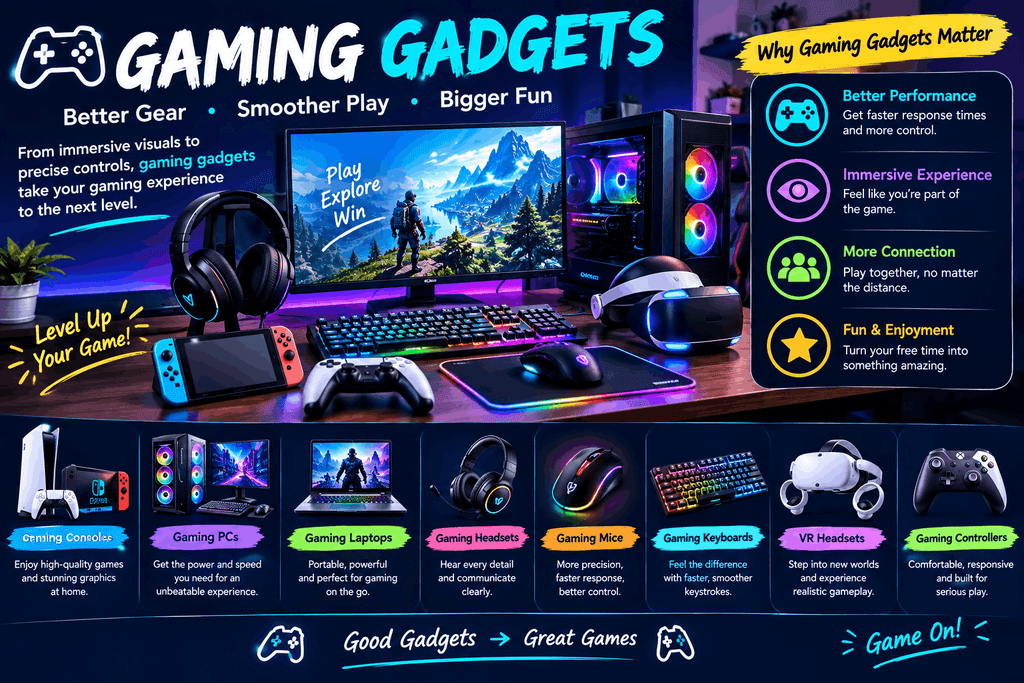
Gaming has developed into a major technology industry, and gaming gadgets are becoming increasingly sophisticated. Consoles, gaming laptops, controllers, gaming monitors, keyboards, mice, headsets, and virtual reality devices provide immersive entertainment experiences.
Modern gaming systems offer high-quality graphics, fast loading, online multiplayer capabilities, and digital game libraries. Gaming PCs provide users with extensive customization options, while consoles often emphasize simplicity and ease of use.
Virtual reality is another exciting area. VR headsets can place users inside simulated environments, creating interactive experiences for gaming, education, training, and entertainment.
Gaming accessories can also improve the overall experience. High-refresh-rate monitors can provide smoother visuals, while specialized controllers and headsets can offer greater control and immersion.
Portable Chargers and Power Technology
As people depend more heavily on mobile devices, portable power solutions have become essential gadgets. Power banks allow users to recharge smartphones, earbuds, tablets, and other compatible devices when a wall outlet is unavailable.
Modern power banks can support fast charging and multiple devices. Some include wireless charging capabilities, while others provide multiple ports for simultaneous charging.
Charging technology itself is also developing. Faster charging standards allow compatible devices to reach useful battery levels in shorter periods. Wireless charging provides convenience by eliminating the need for physical cables in supported setups.
When purchasing charging equipment, consumers should pay attention to compatibility, safety certifications, charging capacity, output power, and build quality.
Cameras and Content-Creation Gadgets
The rise of social media, video platforms, podcasts, and online businesses has increased demand for content-creation gadgets.
Digital cameras remain popular among photographers and professional creators, while compact cameras and action cameras offer portability for travel and outdoor activities.
Smartphone cameras have also become powerful content-creation tools. Creators can record, edit, and publish videos using a single device.
Other useful gadgets include microphones, tripods, lighting equipment, gimbals, webcams, and portable recording devices. Together, these tools can help creators produce higher-quality photos, videos, livestreams, and podcasts.
The growth of creator technology demonstrates how gadgets are increasingly becoming tools for both personal entertainment and professional opportunities.
Artificial Intelligence and the Next Generation of Gadgets
Artificial intelligence is one of the most important trends influencing the future of technology. AI-powered features are being introduced into smartphones, computers, cameras, applications, smart home systems, and other gadgets.
AI can help devices recognize images, process speech, summarize information, translate languages, improve photographs, personalize recommendations, and automate certain tasks.
Instead of requiring users to manually perform every operation, future gadgets may increasingly understand natural-language instructions and adapt to individual needs.
For example, an AI-enabled personal device could potentially help organize schedules, manage communications, summarize information, or control compatible smart home equipment.
At the same time, AI creates important questions about privacy, accuracy, security, and responsible use. Consumers will need to understand what data their devices collect and how automated systems make decisions.
Sustainable and Eco-Friendly Gadgets
Technology companies and consumers are paying increasing attention to environmental sustainability. Electronic waste is a major concern because discarded devices can contain valuable materials as well as substances that require responsible handling.
Some manufacturers are working toward more repairable products, recycled materials, energy-efficient components, and longer software support.
Consumers can also contribute by keeping devices longer, repairing them when practical, recycling electronics through appropriate programs, and avoiding unnecessary upgrades.
Buying a durable device that remains useful for several years can sometimes be more practical than replacing a gadget frequently for small improvements.
How to Choose the Right Tech Gadget
With thousands of products available, selecting the right gadget can be difficult. The most expensive device is not necessarily the most suitable one.
The first step is to identify the primary purpose. A student may prioritize battery life and portability, while a photographer may care more about camera performance and storage. A gamer may prioritize graphics performance and display refresh rate.
Budget is another important consideration. Consumers should look at the total cost, including accessories, subscriptions, replacement parts, and future upgrades.
Compatibility is also essential. A gadget should work properly with the devices and platforms already being used.
Finally, durability and software support deserve attention. A device with reliable updates and good build quality may provide greater long-term value than a cheaper product with limited support.
The Future of Tech Gadgets
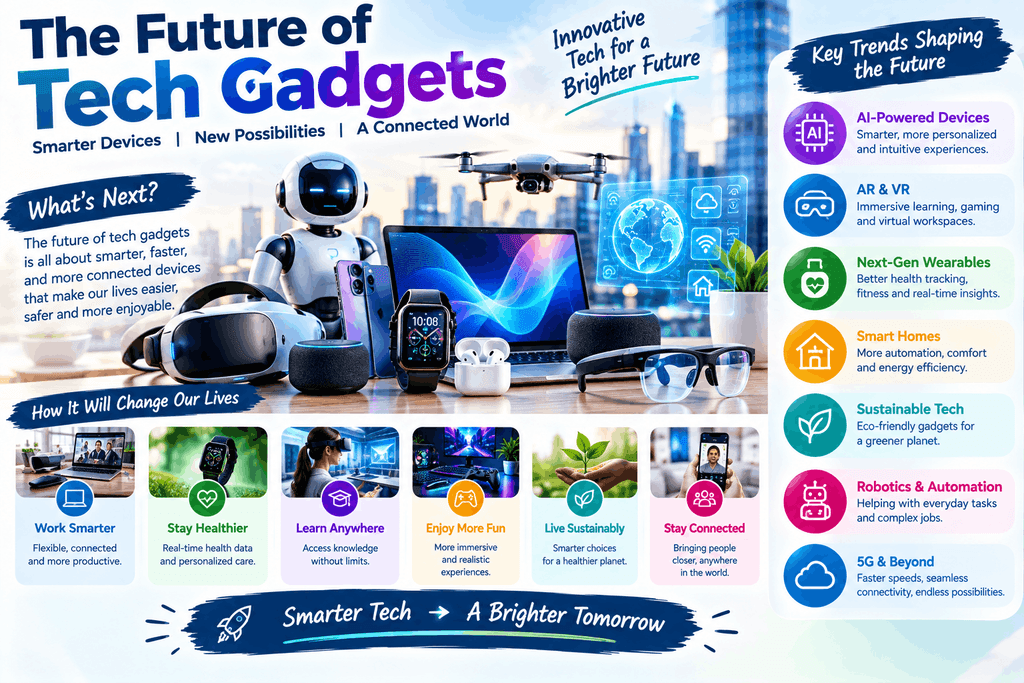
The future of tech gadgets will likely involve greater connectivity, automation, portability, and personalization. Devices are becoming increasingly interconnected, allowing information and services to move smoothly between smartphones, computers, cars, homes, and wearable technology.
Artificial intelligence is expected to play a significant role in this transformation. Instead of simply following commands, future devices may become more context-aware and capable of assisting with complex tasks.
Flexible displays, augmented reality, advanced wearable devices, smart home automation, robotics, and improved battery technology could also influence the next generation of gadgets.
However, technological progress should not be measured only by the number of features added to a device. Usability, security, accessibility, privacy, reliability, and sustainability will remain important.
Conclusion
Tech gadgets have transformed the way people communicate, work, learn, exercise, travel, relax, and entertain themselves. Smartphones, smartwatches, wireless earbuds, laptops, tablets, smart home devices, gaming equipment, and AI-powered technologies are becoming increasingly integrated into everyday life.
The best gadget is not necessarily the newest or most expensive model. Instead, the right device is one that solves a real problem, fits the user’s needs, works reliably, and provides useful value over time.
As technology continues to evolve, gadgets will become more connected and intelligent. Consumers will have more choices than ever before, making it increasingly important to understand both the benefits and limitations of new technology.
The future of tech gadgets is not simply about creating smaller and faster devices. It is about creating technology that fits naturally into human lives, saves time, expands possibilities, and helps people accomplish more while maintaining security, privacy, and responsible use.